 Indian Conservation Architects Community
Indian Conservation Architects Community
Indian Conservation Architects Community
Name of the Society: Indian Conservation Architects’ Community

7/10, First Floor, Sarvapriya Vihar, New Delhi – 110016
The Society shall work in the Territory of India and its rules and bye-laws will be applicable only in the Territory of India.
The Objectives of the Society shall be as enumerated below:
(a) To provide professional membership to conservation architects in India.
(b) To maintain high standards of professional competence, integrity and ethics with the members.
(c) To promote the interest and recognition of those engaged in the practice of Heritage Conservation.
(d) To advance the study of Heritage Conservation and related subjects, and of the sciences and arts as applied to them.
(e) To foster awareness of the subjects related to Heritage Conservation in theory and practice amongst the general public and professionals.
(f) To consider issues and challenges affecting the practice of Heritage Conservation and to watch over measures affecting, or likely to affect, heritage sites and to procure changes of, and amendments in, the law relating to or affecting the protection, conservation and management of heritage sites.
(g) To create awareness of the necessity of community involvement and traditional craftsmanship for sustainable heritage protection, conservation and management.
(h) To promote, endorse and encourage professional development in Heritage Conservation.
(i) To discuss issues and publish information aimed at raising Heritage Conservation standards.
(j) To establish, maintain and publicize standards of professional and technical certification in conservation practice.
(k) To maintain and distribute a directory of accredited members.
(l) To hold conferences and meetings for the discussion of, and the exchange of views on, matters relating to Heritage Conservation, the reading of papers and the delivery of lectures; and to hold congress (either jointly or with any other body or institution or not) for the exposition of any matters affecting the theory or practice of Heritage Conservation or any allied subject; and to award medals, prizes or certificates in connection therewith.
(m) To facilitate interaction and dialogue between conservation architects and heritage professionals from related fields of specialization.
(n) To network and collaborate with like-minded professional bodies to enhance and promote professional development in conservation amongst other professional bodies in the similar/ allied fields.
(o) To establish a sound corpus of knowledge relevant for conservation policy and practice based on scientific research and experience in the field.
(p) To consider all measures related to cultural heritage policy and legislation to achieve integrated and sustainable conservation objectives.
(q) To render advice and provide professional assistance to Central and State Governments, ULB’s, PSU’s or organization under the governments and private sector for various projects or schemes promoted by said organizations through members of the Society.
(r) To form and acquire by purchase, donation, bequest or otherwise a library and collection of archival data or other material, in all medium and to maintain, extend and improve the same.
(s) To accept any gift, endowment or bequest made to or for the Society or to carry any trust; such gift, endowment or bequest.
All the incomes, earnings, movable or immovable properties of the Society shall be solely utilized and applied towards the promotion of its aims and objectives as set forth in the Memorandum of the Society and no profit thereof shall be paid or transferred directly or indirectly by way of dividends, bonus, profits or in any manner whatsoever to the present or past members of the Society or to any person claiming through anyone or more of the present or the past members.
No member of the Society shall have any personal claim on any movable or immovable properties of the Society or make any profits, whatsoever, by virtue of this membership.
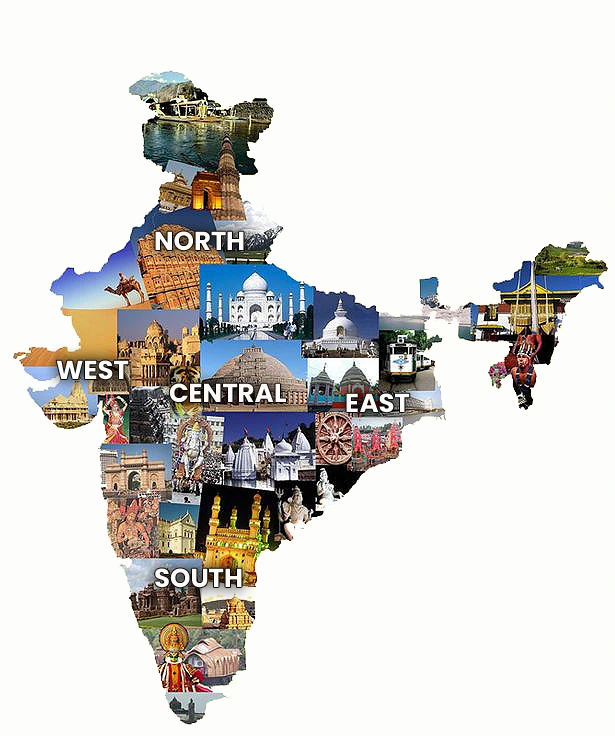
It is proposed to have five zones and the body/organization would function under the following: –
1. North Zone Committee
2. South Zone Committee
3. Central Zone Committee
4. West Zone Committee
5. East Zone Committee
Area of Jurisdiction of Northern Zone: –
Northern Zone will comprise of the States: Jammu and Kashmir, Himachal Pradesh, Uttarakhand, Punjab, Chandigarh (U.T.) and Delhi (U.T.). Each committee would consist of a Zonal Chairman, Secretary and Treasurer. The first/initial committee would be appointed/co-opted by the National Committee for a period of 3 years following which there will be voting by secret ballot. It will be headquartered in New Delhi
Area of Jurisdiction of Southern Zone: –
Southern Zone will comprise of the States: Andhra Pradesh, Telangana, Karnataka, Kerala, Tamil Nadu, Pondicherry, Andaman and Nicobar Islands (U.T.) and Lakshadweep (U.T.). It will be headquartered in Hyderabad.
Area of Jurisdiction of Central Zone: –
Central Zone will be consisting of the States: Uttar Pradesh, Bihar, Madhya Pradesh and Chhattisgarh. It will be headquartered in Bhopal
Area of Jurisdiction of Western Zone: – Western Zone will comprise of the States: – Gujarat, Rajasthan, Maharashtra, Daman and Diu (U.T.) and Goa. This zone will be headquartered in Mumbai
Area of Jurisdiction of Eastern Zone: –
Eastern Zone will comprise of the States: West Bengal, Assam, Sikkim, Arunachal Pradesh, Manipur, Mizoram, Nagaland, Tripura, Meghalaya. This zone will be headquartered in Kolkata.
Central Committee- The Central Committee will be headquartered in New Delhi or any other metropolitan city with the full consent of all the members. The central and zonal committee will meet every quarter and the zonal meetings for every quarter will be held on rotation basis in all the state capitals and U.T.’s of that particular zone. The tenure of all the committees will be for a period of three years.
